4ga Boards
- Platform
- Docker
- Licence
- MIT Open source
- Website
- 4gaboards.com
- Source code
- github.com/RARgames/4gaBoards
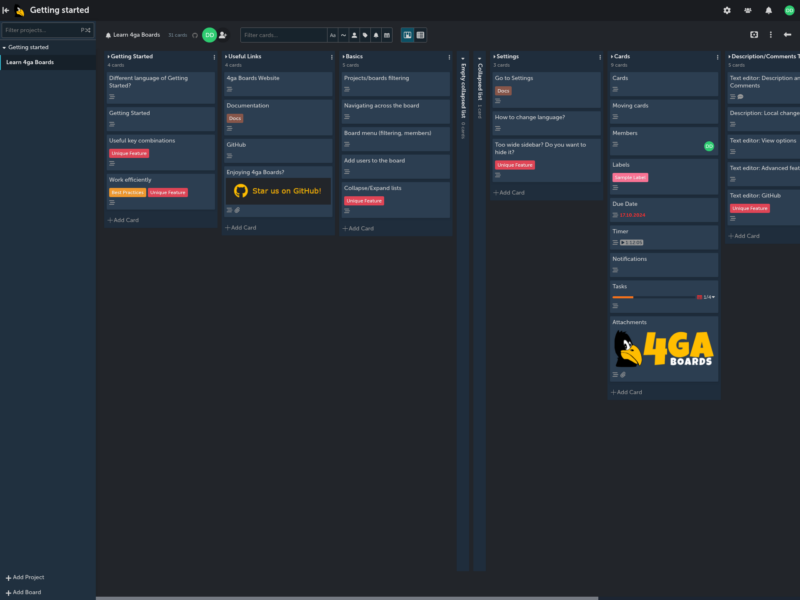
4ga Boards is a self-hosted, real-time kanban board for project and task tracking. It organises work in a four-level hierarchy – projects, boards, lists, cards – and adds sub-tasks inside each card, so a team can keep a whole portfolio on one installation instead of one board per file. The interface is a single-page web app that updates in real time: a card moved by one person appears in its new list for everyone else without a reload.
What it does
- Projects, boards, lists, cards and tasks in one hierarchy, with collapsible lists and a compact or wide sidebar.
- Markdown editor with live preview for card descriptions and comments; local description changes survive while you review other cards.
- Multitasking workflow: filter and rearrange a board while editing a card, keeping the unsaved description edits.
- Labels, members, due dates (including ranges), timers, checklists and per-card attachments.
- Board import and export, including a Trello importer, so an existing board can be brought across.
- Keyboard-first operation with shortcuts for navigation, filtering and card creation.
- Translated into more than fifteen languages, with light and dark themes and a wide-screen layout that keeps the board itself in view.
Requirements and deployment
4ga Boards is a Node.js application that needs PostgreSQL and Redis. The recommended install is Docker Compose: three containers (application, PostgreSQL, Redis) plus a short set of variables – BASE_URL, a random SECRET_KEY from openssl rand -hex 64, and matching PostgreSQL and Redis passwords. The application listens on port 1337 inside the container, mapped to 3000 in the example compose file, and a backup/restore pair of shell scripts ships with it. Kubernetes, TrueNAS and manual installs are documented as well.
Accounts are local, or SSO through Google, GitHub, Microsoft or any OIDC provider; registration can be closed once the team’s accounts exist. The project also sells professionally hosted instances for teams that would rather not run the stack themselves – the same software, operated by the vendor.
Where it fits
It is closest in shape to Planka and Wekan: a Trello-style board you host yourself. The project/board/list hierarchy and the list view – cards as rows with labels, members, due dates and task counts – go further than a single board, which is what makes it workable for several projects on one instance. If you only need one small board, a lighter tool will do; if you want ticket queues or Git-based workflows, a different class of tool fits better.