Parseable
- Platform
- Linux Docker Web
- Licence
- AGPL-3.0 Open source
- Website
- parseable.com
- Source code
- github.com/parseablehq/parseable
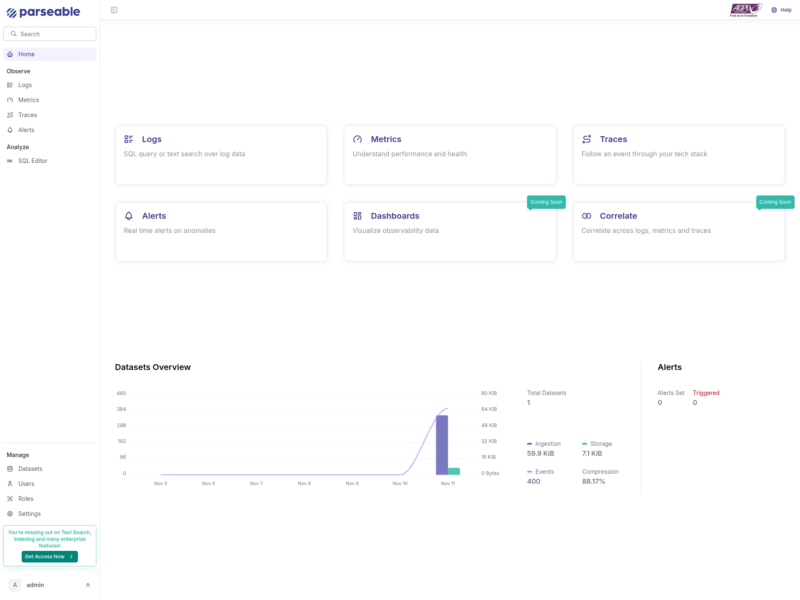
Parseable is an observability platform for logs, metrics, traces and events that keeps the data in object storage and the compute stateless. Rather than a columnar database with its own indexes and retention policy, it writes every stream to Parquet files on S3, MinIO or a local disk and queries those files directly. Everything ships as one Rust binary, so a working install is a download and a login instead of a pile of Helm charts.
What it does
- Collects logs, metrics, traces and events into named streams, each stored as Parquet on object storage
- Ingests over the HTTP API, OpenTelemetry, Kafka or the usual agents (Fluent Bit, Fluentd, Vector), so an existing pipeline keeps working
- Queries with SQL or PromQL from a built-in editor, with streaming search results over the stored files
- Includes alerting, dashboards and anomaly detection in the same binary rather than as a separate service
- Users, roles and per-dataset usage views for access control and capacity checks
- Columnar compression with dictionary and bloom-filter pruning, which is where the storage savings come from
Why object storage instead of a database
The design target is cost: telemetry that nobody queries for 30 days should not sit in an indexed hot tier. Because the backing store is plain Parquet, storage and compute scale separately — you can grow retention without growing the query tier, and read the same files with DuckDB, Spark or anything else that speaks Parquet if you ever want to leave. The trade-off is that search over high-cardinality text is weaker than an inverted index gives you; that is the part Parseable reserves for its paid tier.
Ingest and query
The install script drops the binary on the machine and starts it on port 8000. Sending data is a POST to /api/v1/ingest with an X-P-Stream header naming the stream and Basic auth; the first run creates a stream on the fly, and the default login is admin / admin, which should be changed before anything leaves localhost. From the UI you get a home dashboard with ingest and storage totals, an SQL editor, and a PromQL mode for anyone used to Prometheus.
Deployment
A single container or binary with a --local-store style setup is enough for a laptop or a small internal deployment; the documentation covers Kubernetes, Docker Compose, bare metal and Railway for larger setups, with separate ingestion, query and compaction nodes when the volume justifies it. Configuration and the API are also documented for teams that want to drive ingestion entirely from CI or an agent fleet.
Project and licence
Written in Rust under AGPL-3.0, with active development and a commercial cloud and enterprise edition on top. The open-source edition is the full platform minus the enterprise-only text search and indexing features.
Alternatives
- Grafana — visualisation and alerting across many data sources, usually paired with a separate store
- Grafana Loki — index-free log aggregation that also keeps the compressed chunks in object storage