OxiCloud
- Platform
- Docker Linux macOS Web
- Licence
- MIT Open source
- Source code
- github.com/AtalayaLabs/OxiCloud
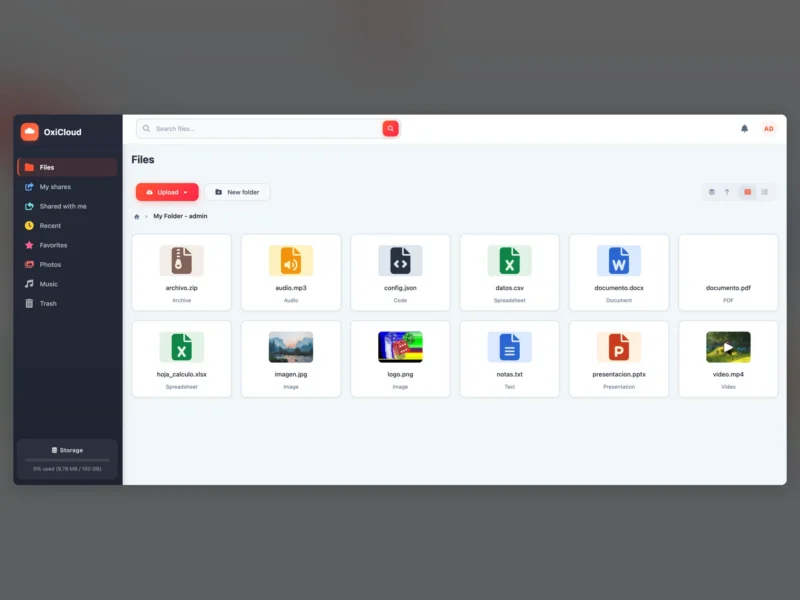
OxiCloud is a self-hosted cloud storage suite written in Rust: one web interface for files, photos, calendars and contacts, with WebDAV, CalDAV and CardDAV built in rather than bolted on through plugins. It began in February 2025 as an answer to a simple complaint about Nextcloud and ownCloud deployments — that a personal or small-team cloud should not need a PHP stack, a dozen apps and a large database just to serve files and calendars — and it now ships Docker images, a Compose file, a Helm chart, a Nix module and a single self-contained binary for Linux and macOS.
Files in the browser, standards underneath
The web UI covers the everyday workflow: multi-file upload, folders, inline previews and thumbnails, chunked uploads, deduplication, search, favourites, recent items, shared links and a trash can. Everything that matters for access is a standard protocol instead of a proprietary sync agent, so the same account opens from macOS Finder, Windows Explorer, GNOME Files, KDE Dolphin or any WebDAV client. Calendars and contacts reach Thunderbird, Apple Calendar and Contacts, and DAVx5 on Android.
Accounts, sharing and office editing
- JWT sessions with Argon2id password hashing, plus optional OIDC/SSO for deployments that already have an identity provider.
- Per-user quotas, admin and user roles, and expiring shared links for files and folders.
- A REST API for automation, and WOPI support so documents can be edited in the browser through Collabora Online or ONLYOffice instead of being downloaded first.
- PostgreSQL as the only database dependency; configuration is entirely environment variables, which is what makes the Helm and Nix packaging practical.
What it deliberately does not do
This is a smaller product than Nextcloud, and the project says so: it is not trying to mirror that plugin ecosystem, aiming instead for fast startup, low idle memory and standards-based interoperability. The roadmap is honest about the gaps — native desktop sync clients and mobile apps are still listed as planned, DAVx5 calendar and contact behaviour is described as still being refined, and end-to-end encryption is a roadmap item rather than a feature you can switch on today. For anyone who needs a desktop sync client on day one, that is a real reason to wait or to run Nextcloud instead.
The engineering bet is test coverage: more than 4,500 automated tests run on every change, across Rust unit and integration tests, frontend tests, API wire tests, end-to-end browser flows and WebDAV compliance, with a stated rule that a fixed bug ships the test that would have caught it in the same patch.
Running it
The quickest path is Compose: clone the repository, copy the sample environment file that ships with it, set OXICLOUD_BASE_URL if the instance will sit behind a domain or reverse proxy, and bring the stack up; the interface then answers on port 8086. Released binaries for Linux musl (amd64 and arm64) and macOS (Intel and Apple Silicon) bundle the frontend, the operator subcommands and the migrations into one executable, and cargo binstall oxicloud works once a release is out. Building from source needs Rust 1.93 or newer and PostgreSQL.
If you are weighing it against the incumbents, the closest comparisons in this directory are Nextcloud for the full app platform, ownCloud for the enterprise lineage it imitates, Seafile for library-based file sync, and Filestash for a browser front end over storage you already have.