pad.ws
MIT
- Platform
- Web Docker Linux
- Licence
- MIT Open source
- Website
- pad.ws
- Source code
- github.com/coderamp-labs/pad.ws
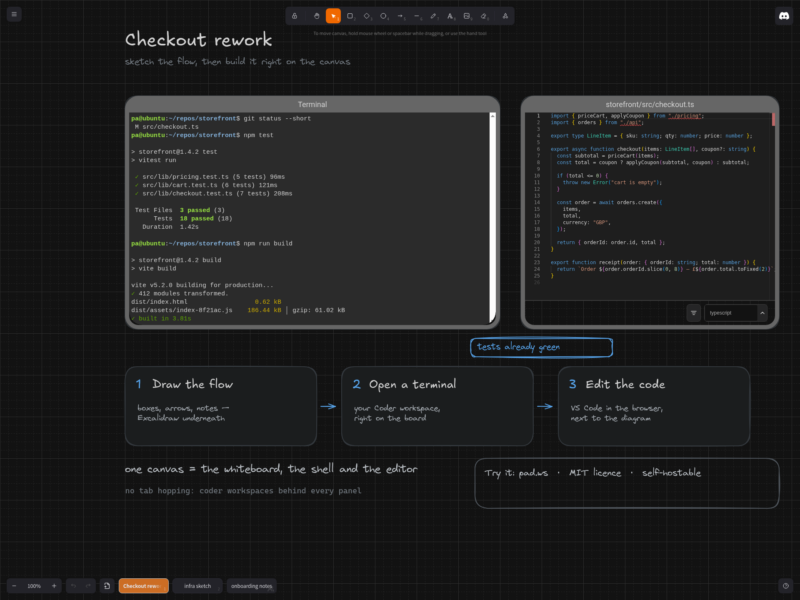
pad.ws is an attempt to merge two tools that normally sit in separate windows: an infinite Excalidraw whiteboard and a full development environment. You sketch a plan on the canvas, then open a terminal or an editor on the same board and start building next to the drawing, with the session running in a cloud VM that the browser connects to.
Whiteboard and development environment on one canvas
- The drawing surface is Excalidraw: shapes, arrows, freehand strokes and text on an infinite board, with the usual pan, zoom and zen-mode controls.
- Cloud development environments are powered by Coder, so each pad gets its own container-backed workspace rather than a shared demo shell.
- Panels live on the canvas itself, so a terminal running a build can sit beside the diagram that explains it.
- Because everything runs in the browser, the same pad can be opened from another machine without carrying a laptop configuration around.
Terminals and editors
- A terminal opens inside the pad, and VS Code opens either in the browser or through a desktop VS Code or Cursor client connected to the same workspace.
- Command snippets can be placed on the canvas with a button that runs them in the pad’s terminal, which makes setup instructions executable instead of copied by hand.
- The official hosted instance at pad.ws offers free Ubuntu environments during its beta, with no installation step.
Running your own
- The project is MIT licensed and the repository ships a Docker Compose stack: PostgreSQL for canvases and configuration, Redis for sessions, Keycloak as the OpenID Connect provider, and Coder for the environments.
- The setup is documented step by step, including creating the Keycloak realm, client and user before the pad app can authenticate against it.
- It expects a Linux host, and the maintainers state plainly that the provided compose file is meant for development and testing rather than as a hardened production deployment.
- Self-hosting means running the Coder control plane and its workspace provisioner alongside the pad application, so the resource footprint is considerably larger than a single-container note app.
Project status
- pad.ws was released as open source in 2025 and has attracted a large following, but the code has not been pushed since August 2025, so the current release should be treated as a working beta rather than an actively developed project.
- The hosted service itself warns that it is a beta and advises backing up your work, which is worth heeding before making it the only home for something important.