Docusaurus
- Platform
- Linux macOS Windows
- Licence
- MIT Open source
- Website
- docusaurus.io/
- Source code
- github.com/facebook/docusaurus
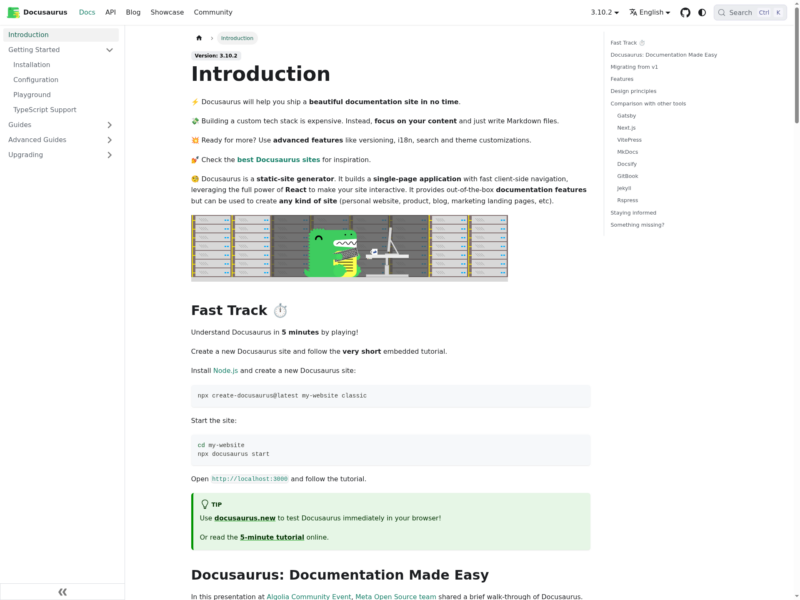
Docusaurus is an open-source static site generator built for documentation websites and maintained by Meta. You write docs, blog posts and landing pages in Markdown or MDX, run the Node CLI, and it compiles them into a fully static site — complete with versioned documentation, a blog, localisation and search hooks. Nothing is generated at request time: the output is plain HTML, CSS and JavaScript, so it can be hosted on GitHub Pages, Netlify, Vercel, an object bucket or any web server, with no database and no server-side runtime to keep patched.
Key Features
- MDX content — Docs, blog posts and pages are written in Markdown, with MDX letting you drop live React components into the middle of a page
- Versioned documentation — Keep the docs for v1, v2 and the current release side by side, with a version switcher in the navbar
- Built-in blog — Dated posts with authors, tags, feeds and pagination, generated from the same Markdown tree as the docs
- Localisation — Per-locale content trees with a language dropdown, so a community can translate the site without forking it
- React theming — The whole layout is React; themes and plugins add features, and component swizzling lets you replace any piece of the UI without forking the framework
- Fast client-side navigation — Pages preload and route in the browser, with prefetching, automatic code splitting and a dark mode toggle
- Search integration — Optional Algolia DocSearch wiring, or any client-side search plugin, since the built site is just static files
- Zero-dependency deployment — The build output needs no PHP, Node or database on the server; an rsync or a CDN upload is the whole deploy
Why Use Docusaurus?
Documentation that lives in git is documentation that gets reviewed. With Docusaurus a docs change is a pull request next to the code change it describes, and the same static build that runs on a laptop is the one served to readers. That removes the usual wiki failure mode of an install, an account system, a database backup and an upgrade path for a site that is mostly text. Versioning is the other reason teams pick it: API and SDK documentation can keep an accurate page for every released major version instead of overwriting the old one. The trade-off is that non-technical editors need a git workflow, or a CMS bolted on top, rather than a browser editor.
Use Cases
- Open source project docs — Installation, guides and API reference for a library, kept in the same repository as the code
- Versioned product documentation — Parallel doc trees per release, with the navbar pointing readers at the version they actually run
- Developer portals and SDK sites — MDX pages that embed live examples, endpoint tables and interactive samples
- Release notes and changelogs — The integrated blog turns dated posts into a feed for announcements and version notes
Docusaurus 3.10 needs Node 20 or newer. The generated site is static, so it can be hosted anywhere.
Licence
MIT for the code, so it can be used and modified commercially. The Docusaurus documentation content itself is published under a Creative Commons licence, which affects copying the docs text, not building with the tool.