FOSS Face-Off: Gramps Web vs webtrees vs GeneWeb — Best Open Source Genealogy Software
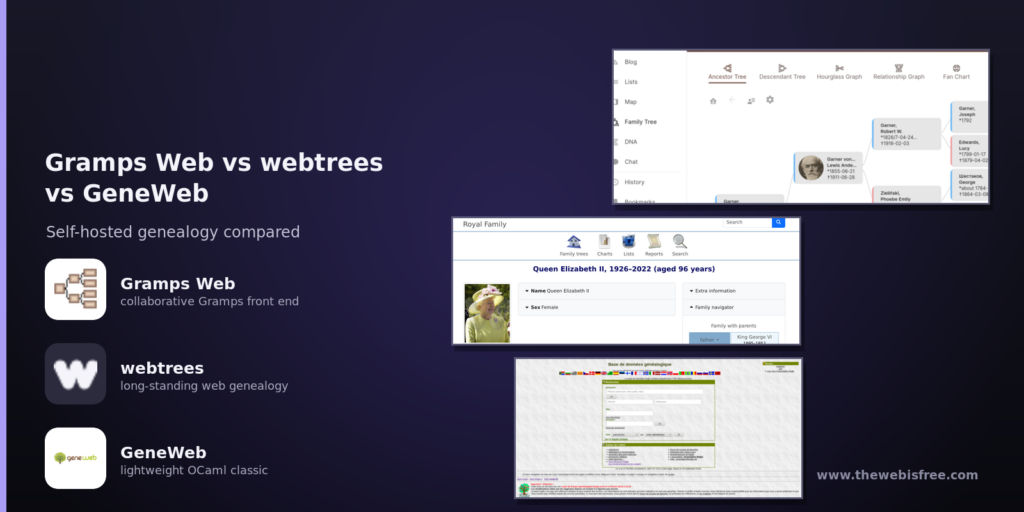
Family history is the one kind of data you can never recreate. Once a subscription lapses, most hosted genealogy services keep the tree behind their paywall and you are left exporting GEDCOM files from a platform you no longer pay for. Self-hosting puts the tree, the media and the access rules on hardware you control, and lets relatives browse it without an account or a licence fee.
Three open source applications cover that ground, and they come from very different traditions. Here is how Gramps Web, webtrees and GeneWeb compare for anyone keeping a real family tree.
1. Gramps Web — The Collaborative Front End for Gramps
Gramps Web is the web application built on top of Gramps, the long-running desktop genealogy program. If you already keep your research in Gramps, this is the shortest path to a shared tree: it reads the same database format, so your local research and the family’s online copy stay the same data rather than two divergent exports. It is licensed AGPL-3.0, and the project is actively developed — v26.11.1 was published on 7 November 2026.
It is a modern application: a responsive interface with charts, maps, a media gallery and full-text search, packaged for Docker so a self-hoster can run it alongside the usual database and object-storage containers. Collaboration is the point — several people work on one tree, and contributions are attributed.
- Stack: a Python backend with a JavaScript front end, deployed with Docker Compose.
- Lineage: reads Gramps databases directly, so desktop research and the web copy are one dataset.
- Access: user accounts with defined roles, from owner down to read-only member — a public tree can be shared without handing out editing rights.
- Community: around 1.8k GitHub stars, with a fast release cadence.
2. webtrees — The Long-Standing Web Standard
webtrees has been the reference web genealogy application for well over a decade, and its priorities show it: GEDCOM 5.5.1 fidelity, careful privacy handling, and a mature module system for charts, reports and research tools. It is written in PHP against MySQL and licensed GPL-3.0; the current release is 2.2.6 (29 April 2026). Because it is a PHP application with a conventional installer, it runs on almost any shared or self-managed web host.
Privacy is where webtrees earns its reputation: each tree carries its own privacy settings, so you can publish while hiding living individuals and decide which visitors — anonymous, members or managers — see what. Charts, lists and reports are configurable, and add-ons bring maps, research logs and themes.
- Stack: PHP with MySQL, installed like any classic web application.
- Privacy: per-tree rules for living people and per-role visibility — the reason many published trees run on webtrees.
- Extensible: themes and modules for charts, reports and research tooling.
- Community: a long-established user base and a public demo tree you can click through before installing.
3. GeneWeb — The Lightweight Classic
GeneWeb is the oldest of the three and the least conventional: an OCaml application, licensed GPL-2.0, that runs either as a local program or as a web server serving a “base” of genealogy data. Its interfaces are plain HTML, which is exactly why it scales — GeneWeb powers some of the largest public genealogy databases in the world, including Roglo, with millions of individuals served from modest hardware.
It is not the tool to pick for a polished modern interface. It is the tool to pick when you want a tree that loads instantly, runs on cheap hardware and has been stable for twenty years. Release cadence is slow: the most recent GitHub tag is v7.1.0-beta2 (December 2025).
- Stack: OCaml, compiled binary plus a static data base — no PHP, no database server.
- Scale: proven on bases with millions of individuals and heavy public traffic.
- Privacy: a private mode that hides recent individuals behind a password, for hosting a tree publicly without exposing the living.
- Community: smaller and older, with documentation and a wiki rather than a busy forum.
Head-to-Head Comparison
GEDCOM fidelity. All three are GEDCOM-centric, but webtrees treats the format as its native model, GeneWeb imports it into its own base, and Gramps Web inherits Gramps’s importer — generally the most forgiving of the three with messy real-world files.
Multi-user editing. Gramps Web is built for it, with accounts and roles from the start. webtrees has mature per-role permissions. GeneWeb is closer to a single curator publishing a base than to a wiki.
Hosting footprint. GeneWeb is the lightest by far: a binary and some files. webtrees needs PHP and MySQL. Gramps Web wants Docker Compose with a database and object storage.
Offline use. Gramps Web’s parent application is a desktop program, so your research continues without a server. webtrees and GeneWeb are web applications first; GEDCOM export is your offline copy.
Community and cadence. Gramps Web ships most often, webtrees releases steadily on a mature codebase, and GeneWeb changes slowly by design.
Which One Should You Pick?
Choose Gramps Web if: you already use Gramps, or you want one dataset shared between desktop research and a family website with real user roles.
Choose webtrees if: you want the most battle-tested web genealogy application, careful privacy rules for living people, and a conventional PHP host.
Choose GeneWeb if: you want a fast, tiny, rock-solid base for a large public tree and do not need a modern editing interface.
The Bottom Line
Genealogy is the clearest case for self-hosting: the data is irreplaceable, the audience is your own family, and the subscription model offers nothing you cannot run yourself. Start with webtrees if you want the safe conventional choice, Gramps Web if you want a modern collaborative tree, GeneWeb if you want the leanest possible server.
Browse the rest of the free and open source tools in the directory, and if a genealogy application is missing, submit a tool and we will review it.