FOSS Face-Off: Tailscale Alternatives for Your Own Servers
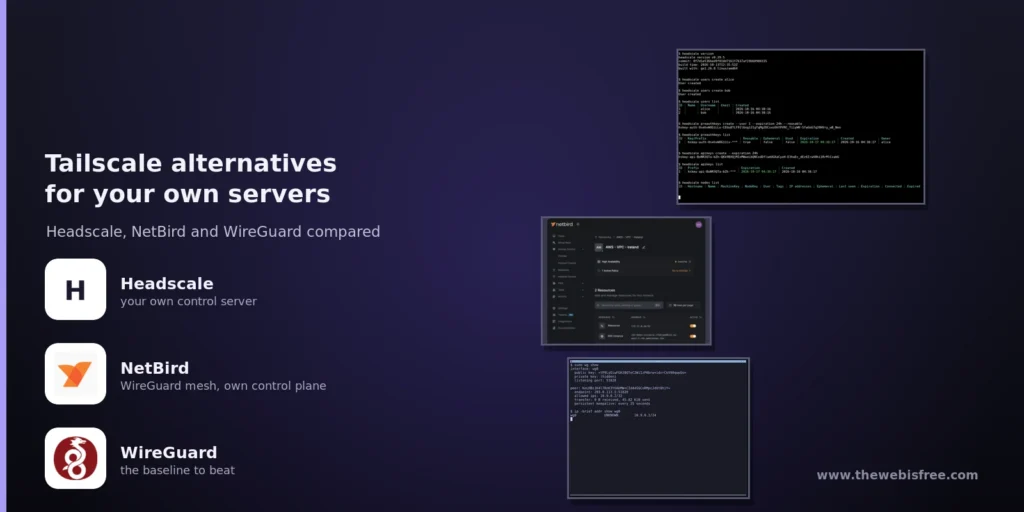
Tailscale is popular for a good reason: it gives you WireGuard tunnels that work through NAT, with addresses, names and access rules, and no public port on your server. The part people push back on is the coordination server — the machine that introduces your nodes is Tailscale’s, not yours. That objection came up repeatedly in a November 2026 write-up about locking down a compromised server, where the replies split between “run WireGuard yourself” and “keep Tailscale, but harden it”.
Both are defensible. What follows is the middle ground: four ways to keep the convenience and own the control plane, plus the baseline they are all measured against. Licences are from each project’s own repository; pricing is what the vendor pages printed in November 2026 and will move.
What you actually replace
Tailscale’s data plane is WireGuard. The product is everything WireGuard does not ship: identity, addresses, DNS names, access rules, NAT traversal, and relay servers for when a direct path fails. Its client is open source under BSD-3-Clause; the hosted coordination server is not.
So there are only three moves: keep Tailscale’s clients and replace the control server (Headscale), replace the whole stack with a control plane you host (NetBird, Nebula, ZeroTier), or drop the coordination layer and exchange keys yourself (plain WireGuard).
Headscale — Tailscale’s clients, your control server
Headscale is an independent, self-hosted implementation of the Tailscale control server, BSD-3-Clause licensed, and the closest thing to a drop-in swap: the official Tailscale clients connect to it. You run it, patch it and back it up, and its scope is deliberately narrower than the hosted product — one tailnet, aimed at one person or a small group willing to operate the server.
The failure mode has the same shape as Tailscale’s: existing tunnels keep working while the control server is down, but new enrolment, key refreshes and access-rule changes stop. If the objection was “I do not want someone else’s server in the path”, this answers it. If you wanted zero maintenance, it does not.
NetBird — a WireGuard mesh with its own control plane
NetBird builds its own overlay on WireGuard rather than piggy-backing on Tailscale’s clients, and it is designed to be self-hosted from the start: a management server, a signal server and relays that you run. Access is identity-based, and the product ships a real management dashboard rather than a CLI.
Read the licence before you build on it. Most of the repository is BSD-3-Clause, but management/, signal/, relay/ and combined/ are AGPL-3.0. That split is common in open-core networking, and it matters if you embed the control plane in something you ship.
Nebula — certificates, not accounts
Nebula is Slack’s MIT-licensed overlay, and it inverts the model: there is no accounts service and no per-seat fee, because there is no hosted plan in the project itself. You run a certificate authority and a set of lighthouse nodes so peers can find each other, and group membership in each node’s config decides who is allowed to talk. Certificates expire, which is the point — revoking a host is a matter of not renewing it.
Nebula is not a WireGuard wrapper; it has its own encrypted transport. The trade is explicit: no control plane to trust and nothing to pay per user, in exchange for running the CA and the lighthouses yourself.
ZeroTier — a different protocol, priced per device
ZeroTier describes itself as a smart Ethernet switch, and that is the honest framing: it offers layer-2 semantics rather than a routed WireGuard mesh, which is either exactly what you need or entirely irrelevant. The client repository is mostly MPL-2.0, with a nonfree/ tree that is source-available rather than open source, and the hosted controller is the product.
The pricing follows the protocol: per device rather than per seat, with a free personal tier, and self-hosted deployment listed on the enterprise plan. Treat it as an alternative to the problem, not a drop-in replacement for Tailscale.
Plain WireGuard — the baseline to beat
WireGuard’s kernel components are GPLv2, and a tunnel is exactly two things: a key pair and an endpoint. wg-quick brings an interface up from a config file, and that is the whole feature set. There is no name service, no access policy, and no NAT traversal for a peer that must accept connections after the traffic goes quiet. Every tool above exists to add those things.
For two or three fixed machines on networks you control, that is not a limitation — it is the absence of a dependency.
How to choose
- Tailscale’s clients without Tailscale’s server → Headscale.
- A hosted-style experience you can self-host, with a dashboard and policies → NetBird.
- No accounts service at all, and you will run a CA → Nebula.
- Layer-2 semantics, or device-based rather than seat-based pricing → ZeroTier.
- Two or three machines and you do not mind key exchange → WireGuard.
Two things that still bite after the move
Moving SSH onto the overlay does not close a port that Docker published. Docker’s published ports are handled in the nat table, before ufw’s INPUT chain, so a database can stay reachable on the public IP long after SSH has moved to the private network. Bind the container to 127.0.0.1 or to the overlay address instead of the default wildcard.
A mesh that allows every node to every port is a flat LAN. Whatever you pick, write the per-port rules — ACLs and grants in Headscale, policies in NetBird, groups in Nebula — otherwise the private network is just a smaller version of the public one.
The short version
If the objection is the hosted coordination server, Headscale is the smallest possible change: same clients, your server. If you want a control plane with a dashboard and policies you host, NetBird. If you want to own every piece, Nebula. If you want as few moving parts as possible, plain WireGuard still wins.
Browse the rest of the free and open source tools directory, or submit a tool we are missing.