Open Source Security Alert: What You Need to Know (October 2026)
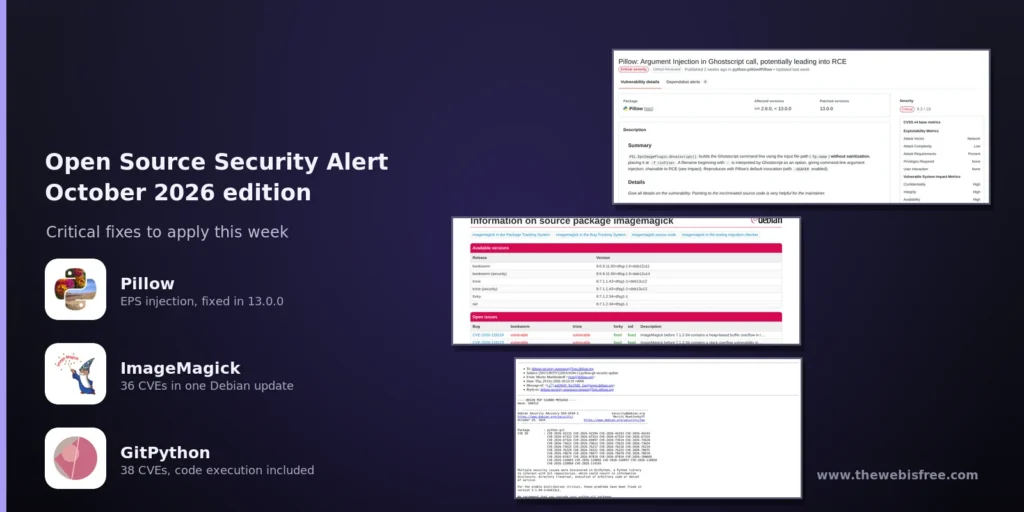
Security patches have been stacking up over the last fortnight. Pillow shipped a release with 42 security fixes, Debian pushed four advisories out in two days covering image libraries, a Git library and the Tor network, and Firefox ESR moved to 153.6.0. Here is what matters, what to check, and what to do — with every version taken from the release notes or the advisory itself rather than a news summary.
The one to fix today: Pillow CVE-2026-112900
Pillow 13.0.0 landed on 16 October, and its worst flaw got a CVE three days later: CVE-2026-112900, rated 9.2 Critical on CVSS 4.0. It affects every Pillow release from 2.6.0 up to, but not including, 13.0.0, and the CVE record lists 13.0.0 as the only fixed version. There is no patch for an older branch.
The flaw sits in Pillow’s EPS plugin. EPS files are PostScript programs, so Pillow shells out to Ghostscript to render them and passes the image’s filename straight after -f without sanitising it. If that filename starts with a dash, Ghostscript reads it as an option instead of a file. If it starts with @, Ghostscript reads further arguments from the text file with that name — and if the attacker controls that file’s contents, they control the command line. That is how argument injection (CWE-88) becomes command execution (CWE-78).
The awkward part is that Pillow passes -dSAFER to Ghostscript by default and it does not help. That flag restricts what a PostScript program can do; it does nothing about arguments injected into the command line itself.
Nobody has reported exploitation in the wild. CISA’s SSVC assessment from 20 October is still sobering reading: exploitation none, automatable yes, technical impact total.
Are you actually exposed?
Only if four things are true at the same time. You run Pillow below 13.0.0, Ghostscript is installed, your code opens an EPS file whose filename an attacker can influence, and the image is loaded or rendered rather than just opened.
Services that generate their own filenames or work from in-memory streams are far less reachable. Full command execution also needs a second foothold: a text file the attacker controls, referenced with a leading @.
If you cannot upgrade this week, there are three decent stopgaps. Save uploads under generated names instead of the name the client sent. Restrict decoding to the formats you actually accept with Image.open(f, formats=["PNG", "JPEG"]). And remove Ghostscript from any image that does not need EPS support — no Ghostscript means no EPS rendering, which closes the vulnerable path entirely.
Pillow 13.0.0 is not a one-bug release
The release notes carry 42 security advisories: 3 Critical, 14 High, 22 Medium and 3 Low. CVE-2026-112900 was filed as a Medium in those notes on release day and only scored 9.2 once GitHub published the CVE record, so the severity lists are worth reading side by side.
Besides the EPS injection, the Critical list includes stale native image storage reused after mode transitions (CVE-2026-96639) and JPEG decoder buffer overflows from scanlines wider than tile extents. The High list is mostly TIFF and PDF parsing: out-of-bounds reads from undersized libtiff buffers, encoder heap overflows, PDF stack exhaustion from long trailer chains.
Two of the High entries have no CVE yet — GHSA-xcvg-w56q-r89m and GHSA-78g4-xqwv-q3g8. If your scanner matches on CVE identifiers alone, it will miss them.
The upgrade is not completely free of risk. 13.0.0 changes behaviour in a few places: duplicate TIFF tags now keep the first value instead of the last, saving I-mode images as PNG no longer silently clips values, and Python 3.10 support is gone. Run your image-processing tests before you roll it out. The release notes and the advisory are both worth ten minutes of your time.
Debian still has no Pillow fix
If your Pillow comes from a distribution package, the copy in the repository is not the one the CVE talks about. Check the distribution’s tracker instead of pip show. Debian’s status as I write this:
- bookworm — 9.4.0-1.1+deb12u1, vulnerable
- trixie — 11.1.0-5+deb13u4, vulnerable
- forky — 12.3.0-1, vulnerable
- sid — 13.0.0-1, fixed
Until Debian ships a fix, install Pillow 13.0.0 from PyPI inside a virtual environment or a container rather than fighting the system package. If your Dockerfile installs Pillow without pinning a patch version, rebuild it with docker build --pull --no-cache so the install step resolves the fixed release. Images that pin a version, such as pillow==12.3.0, need the pin raised first.
ImageMagick: 36 CVEs in a single update
Debian’s imagemagick advisory from 29 October closes 36 CVEs at once. The description is the usual one for image parsers — denial of service, information disclosure, and potentially arbitrary code execution if malformed images are processed. The fixed package for trixie is 8:7.1.1.43+dfsg1-1+deb13u13.
Anything that resizes or converts images uploaded by other people belongs on this one: galleries, thumbnailers, mail gateways, CMS upload pipelines. The same class of bug keeps coming back because the parsing surface is enormous.
GitPython: 38 CVEs, code execution included
GitPython — the python-git package — collected 38 CVEs in its 29 October update, spanning information disclosure, directory traversal, arbitrary code execution and denial of service. The trixie fix is 3.1.44-1+deb13u1.
This one matters most for automation: release scripts, CI helpers and internal dashboards that clone or inspect repositories on a user’s behalf. If GitPython is in your dependency tree, bump it even if you never wrote a line against it.
Tor 0.4.9.15 brings new DoS defences
Tor released 0.4.9.15 on 28 October as a security release, and Debian followed with an advisory the next day. There are no CVE identifiers assigned yet, so this will not show up in most vulnerability feeds.
The substantive change is DoS mitigation: directory caches can now rate-limit BEGIN_DIR cells per circuit, independently of the exit stream creation limit, and refuse a second one from an authenticated relay on the same circuit (that second limit is off by default). Refusals show up in the heartbeat and in the relay’s DoS metrics. The HSDir flag is also sticky across restarts now.
This release mostly affects relays and directory authorities, so if you only run a client you are not in the blast radius — but upgrade anyway. One side effect worth knowing: 0.4.8 and older relays no longer work on the network at all.
Firefox ESR 153.6.0 and the rest of the batch
The 28 October firefox-esr advisory is the biggest of the fortnight at 145 CVEs, fixed in 153.6.0esr-1~deb13u1 for trixie. There is nothing exotic to do here: restart the browser, or push the update through your normal patch window.
Two quieter ones are easy to miss. libheif, the library behind HEIF and AVIF support, was fixed on 24 October (1.23.6-2~deb13u1) for crafted-image denial of service, process memory disclosure and a use-after-free in timestamp handling while encoding. And if you skipped last week’s advisories: nginx, bind9, apache2, expat and the Linux kernel all took security updates in the same stretch.
How to check your own systems
Start with the Python side, because that is where the critical one lives:
python3 -c "import PIL; print(PIL.__version__)"Anything below 13.0.0 needs attention. If it is a virtual environment, upgrade it in place:
pip install --upgrade "pillow>=13.0.0"For distribution packages, ask the package manager rather than the interpreter — and check whether Ghostscript is even present, since that decides whether the Pillow bug is a code-execution path or just an argument-injection nuisance:
apt policy imagemagick python3-git tor firefox-esr libheif1
command -v gs && gs --version
If you want the full picture rather than four package names, Debian publishes every advisory and a tracker page for each package, and both are plain HTML you can diff against your fleet.
The Bottom Line
If you only do one thing this week, check which Pillow your image-handling services actually run and move it to 13.0.0 — a virtual environment pin if your distribution has not shipped a fix yet. Then take the Debian batch: ImageMagick, GitPython, Tor and Firefox ESR in one maintenance window, and libheif alongside them if you handle AVIF or HEIC uploads.
Security work gets easier when you can see what you are running. Our security directory lists open-source tools for scanning, monitoring and intrusion prevention — Trivy for container and dependency scanning, CrowdSec for behaviour-based blocking, Wazuh for host monitoring. All free, all self-hostable, none of them requiring a subscription to stay patched.
Download the Pillow fix at pillow.readthedocs.io — free, no account required.