Woodpecker CI
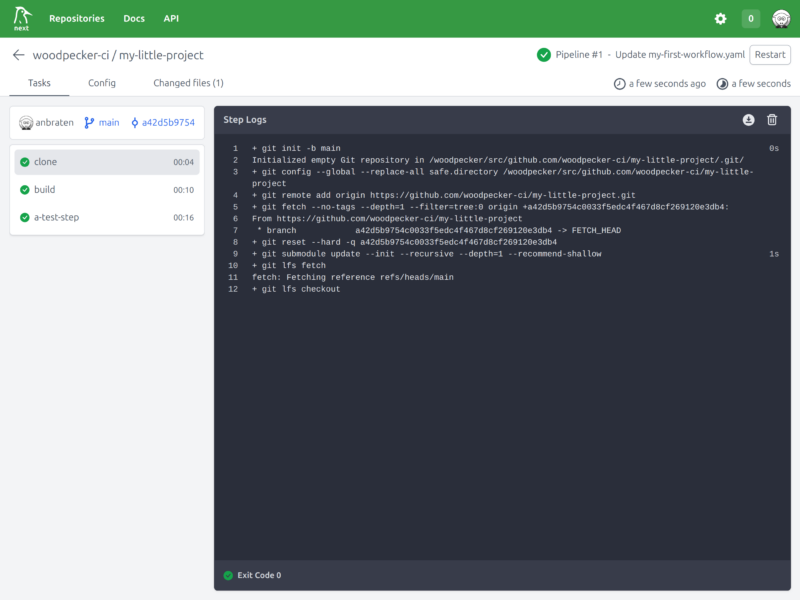
Woodpecker CI is a lightweight, open source continuous integration and delivery engine written in Go. It is a community-maintained continuation of the Drone project, and runs every pipeline step inside an isolated container sourced from the project’s Docker image. Woodpecker integrates with the major open source Git forges, including Gitea, Forgejo, GitHub, GitLab, and Bitbucket.
Key Features
- Container-based steps — each build step runs in a fresh Docker container, keeping environments isolated and reproducible.
- Simple YAML pipelines — describe your workflow in a short, readable
.woodpecker.ymlfile. - Multi-forge support — connect Gitea, Forgejo, GitHub, GitLab, or Bitbucket out of the box.
- Secrets management — store sensitive variables encrypted and inject them only into authorised steps.
- Resource-friendly — a single lightweight binary for the server and per-build agents, ideal for self-hosting.
- Pipeline matrices — run one pipeline across multiple images and parameter combinations.
- Scheduling & approvals — cron-triggered builds and optional human approval gates.
- Fast iteration — no plugin framework to install; any Docker image is a step.
Why Use Woodpecker?
Woodpecker is one of the easiest self-hosted CI/CD systems to run, especially when paired with a self-hosted forge such as Gitea. Because build steps are just Docker containers, you get the isolation of container CI without the resource footprint of a heavier platform, and its Go binaries make it trivial to deploy.
Use Cases
- Continuous integration for self-hosted Gitea or Forgejo repositories.
- Lightweight containerised build and test pipelines on your own hardware.
- Automated packaging, release, and deployment workflows.
- Teams that want pipeline-as-code with minimal maintenance overhead.
Platform
Self-hosted (Go) · Linux · Docker / Kubernetes
Licence
Apache-2.0