OctopusGarden
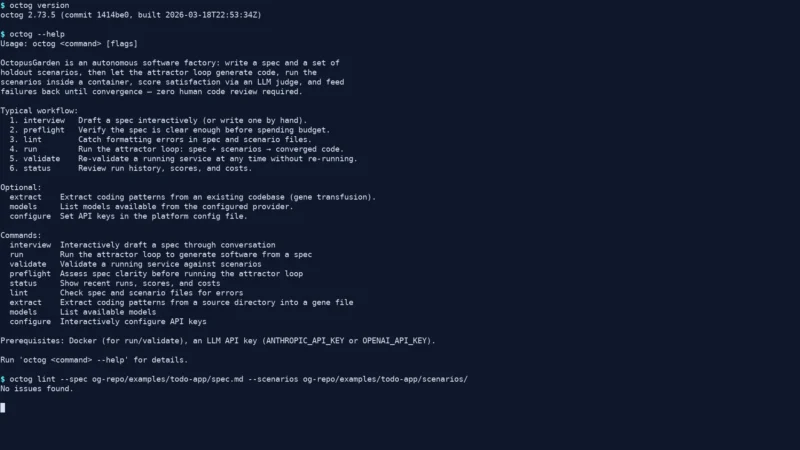
OctopusGarden — the command-line tool is called octog — is an open source “software dark factory” written in Go. You describe the software you want in a Markdown specification and how to verify it in YAML scenarios, then OctopusGarden orchestrates AI coding agents that generate, build, test and iterate on the code until it converges on a working implementation — with no human code review in the loop.
It implements the “software factory” pattern popularised by StrongDM. The scenarios are a holdout set: the agent that writes the code never sees them, and an independent LLM judge scores each scenario step probabilistically (0-100) rather than pass/fail. Because the generator cannot read the tests, it cannot simply optimise against them, and a partial score gives the loop far more to work with than a boolean failure.
Key Features
- Holdout scenarios — Verification scenarios live apart from generation and are only revealed to the validator, so the coding agent cannot game the test.
- Attractor convergence loop — Generate → build in a Docker container → validate → score → feed failures back, repeating until satisfaction passes your threshold (95% by default).
- Probabilistic LLM-as-judge scoring — Every scenario step gets a satisfaction score from 0 to 100, so “nearly right” is distinguishable from “broken”.
- Preflight assessment — An LLM pass rates spec clarity and scenario quality before you spend any generation budget.
- Wonder/reflect stall recovery — When the loop stops improving, a high-temperature diagnosis pass finds the root cause and a low-temperature pass writes a surgical fix.
- Frugal model escalation — Start on a cheap model with
--frugal-model, escalate to your main model after two non-improving iterations, and downgrade again after five consecutive improvements. - Gene transfusion — Extract coding patterns from an existing codebase with
octog extractand bootstrap generation from them withoctog run --genes. - Stratified validation —
--stratifiedvalidates scenarios in ascending difficulty tiers, converging each tier before advancing so easy tests cannot mask hard failures. - Run history and costs —
octog statuslists past runs with per-scenario scores and token costs; each run and iteration is recorded in a local SQLite store. - Interactive spec drafting —
octog interviewdrafts a spec conversationally, optionally emitting holdout scenario YAML alongside it.
Why Use OctopusGarden?
Supervising a coding agent usually means prompt-wait-review cycles and reading diffs you did not write. OctopusGarden replaces that with a loop that verifies its own output: the spec is the approval, and the code ships when the holdout scenarios score above your threshold. It suits well-specified, API-shaped software — CRUD services, REST APIs, terminal tools — where you can write down what “working” means before any code exists.
Use Cases
- Turning a written specification into a working REST service that passes scenarios you wrote, without reviewing the generated code line by line.
- Running the factory unattended on long-horizon tasks, with a defined satisfaction threshold as the stop condition.
- Re-validating an already running service against the same scenarios at any time with
octog validate --target. - Bootstrapping a codebase’s conventions with gene transfusion so generated code matches an existing project’s patterns.
Platform
Linux (amd64/arm64) · macOS (Intel/Apple Silicon) · Windows — single Go binary, also installable via Homebrew. Runs require Docker and an Anthropic or OpenAI API key.
Licence
MIT