KnowNote
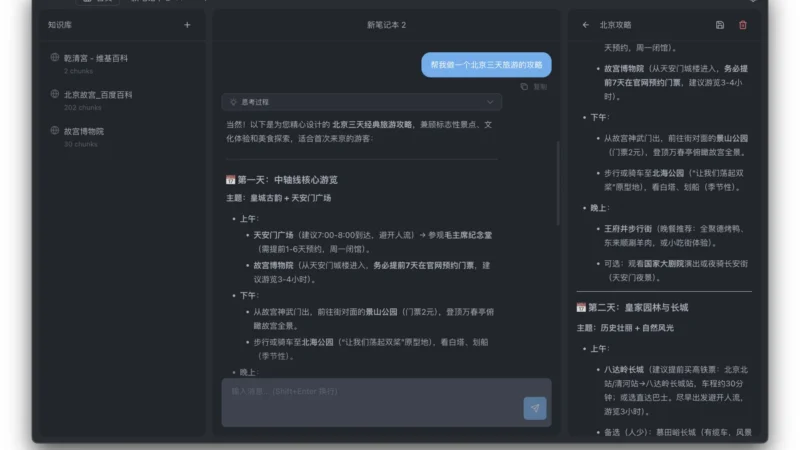
KnowNote is a free and open-source, local-first research workspace — a desktop alternative to Google NotebookLM that runs entirely on your own machine. You import your own documents, ask questions in your own words, and every answer comes back carrying the passage it was built from. Retrieval happens inside the application: the embedder is bundled, the vectors live in a local SQLite file, and nothing is uploaded. It is released under the GPL-3.0 licence, and the current release is v1.5.3 (October 2026).
It is a deliberately single-purpose application rather than a platform: one notebook per question, one built-in embedder, one local database, and no Docker, no server and no account. The only thing it asks for is a model connection — any OpenAI-, Anthropic- or Google-compatible endpoint, or a local server such as Ollama.
Key Features
- Local-first by design — documents, notebooks, notes and embeddings stay on your disk, and the built-in embedder runs inside the application, so import and retrieval keep working with the network off
- Multi-format import — PDF, Word (.docx), PowerPoint (.pptx) and web pages, each through its own parser so page, heading and slide structure survives
- Traceable answers — every answer keeps the passages it was built from, along with the character offsets each passage was cut at, so a citation points at the passage rather than the whole file
- Bring your own model — any OpenAI-, Anthropic- or Google-compatible endpoint, or a local server such as Ollama; there is no bundled chat model and no account, and the credential stays on disk
- In-process embeddings — the multilingual E5-small model (384 dimensions, quantised, pinned to a fixed revision) runs through ONNX inside the app, with remote model loading disabled so retrieval cannot quietly reach out
- One vector space per notebook — sqlite-vec tables sit in the same SQLite database as everything else, and vectors from different embedding spaces are never compared with each other
- Notes and mind maps — keep what you concluded beside the sources in a structured note editor and turn a notebook into a mind map
- Read-only MCP export — serve a library to a local agent (Claude Code, Codex, Cursor) over stdio MCP with search, document-read and note-search tools; there is no write tool and no result that reports a filesystem path
- No deployment — download an installer, open it, add a model connection and start reading: no Docker, no server, no configuration file
Why Use KnowNote?
If your sources cannot leave your machine, a hosted notebook is not an option — and KnowNote is built around that constraint rather than around a feature checklist. Retrieval really is local: the embedder ships with the app, vectors sit in a local SQLite file, and only the final answer request touches the network, going to whichever endpoint you configured. It is also the shortest path to a NotebookLM-style workflow, because there is nothing to deploy and nothing to choose beyond a model. The trade-offs are worth knowing up front: it is early-stage software maintained by a single developer, the builds are unsigned (so Windows and macOS each ask you to confirm once on first launch), there is no Linux build and no Intel Mac build, and it is single-user by construction.
Use Cases
- Reading and questioning research papers, reports and course material without uploading them to anyone’s cloud
- Studying multilingual sources — the embedder is multilingual, so a question in one language can find a passage written in another
- Building a question-driven notebook where the questions you asked, the passages behind the answers and your own notes stay together in one place
- Working offline: import documents and search them with the network off, then connect only when you want an answer
- Letting a coding agent search your own documents through the read-only MCP server instead of pasting text into a chat window
Alternatives
- AnythingLLM — a configurable local-first AI platform with desktop and self-hosted modes, multi-user support and a choice of vector databases, where KnowNote deliberately offers none of that configuration.
- PrivateGPT — a local retrieval-augmented-generation toolkit for querying documents with private models, aimed at developers who want the pipeline rather than a finished app.
- Jan — an open-source desktop AI assistant for running models on your own machine; a good companion when you also want a general chat client.
- Logseq — a local-first outliner and knowledge base, the better fit when your own notes rather than imported documents are the centre of the work.
- Google NotebookLM — the proprietary tool KnowNote is modelled on: nothing to install and stronger hosted models, at the cost of sending your sources to the cloud.
Platform
Windows (x64) · macOS (Apple Silicon) — there is no official Linux or Intel-Mac build; those platforms are build-from-source only.
Licence
GPL-3.0 (free and open source)