FOSS Face-Off: Open Source GitHub Alternatives Compared
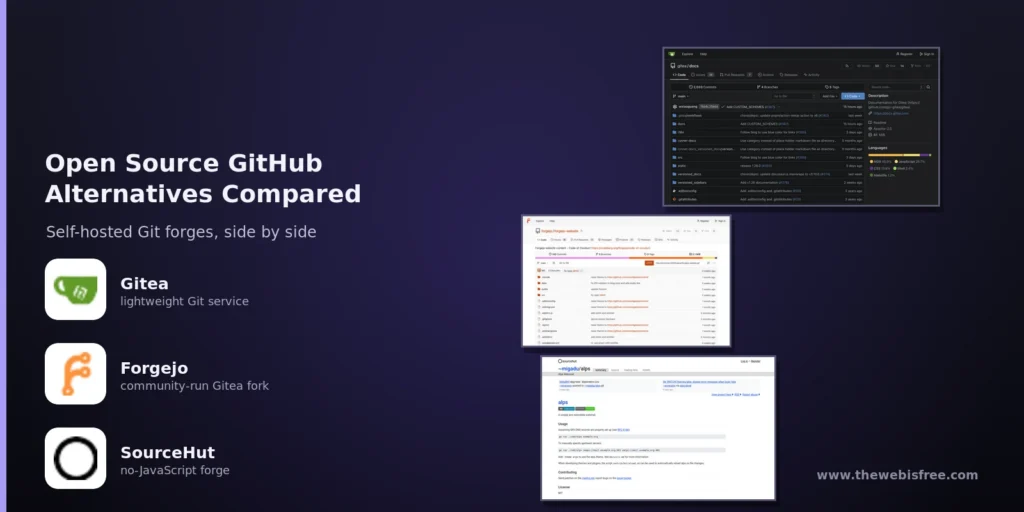
GitHub is where most of the open source world lives — but it is proprietary software owned by a single company, and every repository you push there is somebody else’s platform. If you want the same pull-request, issue-tracker and CI experience without handing your project to a closed service, the good news is that the self-hosted alternatives are mature. Here are the three forges that matter most in 2026: Gitea, Forgejo and SourceHut.
Gitea
Gitea is the project that made “self-hosted Git in a single binary” a reality. Written in Go, it started life in 2016 as a fork of Gogs and has grown into a full DevOps platform: repositories, pull requests, issues, wikis, kanban project boards and a package registry covering more than 20 formats. It is licensed under the permissive MIT License and runs on almost anything Go supports — Linux, macOS, Windows, FreeBSD and OpenBSD.
Its headline feature for GitHub refugees is Gitea Actions, a built-in CI/CD engine that is deliberately compatible with GitHub Actions syntax. Existing workflow files and thousands of community actions can often be reused with minimal changes, which removes the biggest migration headache.
The project is also commercially backed by Gitea Limited, which sells a hosted cloud tier and an enterprise edition with SSO and audit logs. The core stays free MIT software — but that open-core split is exactly what caused the community rift that produced Forgejo.
Forgejo
Forgejo (“I forge” in Esperanto) began in December 2022 as a community fork of Gitea, after the Gitea trademark was quietly moved into a for-profit company. By February 2024 it had become a hard fork, and in August 2024 it relicensed from MIT to the copyleft GNU GPL v3 or later. It is governed by Codeberg e.V., a registered non-profit association, which commits the project to staying 100% free software.
Technically it inherits Gitea’s lightweight, Go-based design — low resource use, Docker-friendly, and able to run on a Raspberry Pi or a NAS. On top of that it adds a strong emphasis on security, scaling and privacy. Forgejo also ships Forgejo Actions, its GitHub-Actions-compatible CI system, and the team is working on ForgeFed — ActivityPub-based federation that lets issues, stars and comments travel between independent forges.
The largest instance, Codeberg.org, hosts more than 300,000 repositories, and the Fedora project has chosen Forgejo to replace Pagure. Note that Forgejo dropped native Windows support in 2024; on Windows you run it in Docker.
SourceHut
SourceHut takes the opposite philosophical approach. Where Gitea and Forgejo clone GitHub’s web-first, JavaScript-heavy experience, SourceHut — “the hacker’s forge” by Drew DeVault — is a collection of small, composable services built around email and Unix conventions. It is licensed under the AGPL v3.
Instead of one monolith you get git.sr.ht for repositories, hg.sr.ht for Mercurial, builds.sr.ht for CI, lists.sr.ht for mailing lists, todo.sr.ht for tickets and chat.sr.ht for IRC. Code review happens through mailing lists and git send-email patches rather than web pull requests, and the core interface is designed to work without JavaScript. The CI runs fully virtualised builds across a range of Linux and BSD images, and you can SSH into a failed build to debug it. Everything is scriptable through the hut CLI, and you can export your entire account with a single command.
SourceHut is both a hosted paid service and self-hostable software. It is the least “GitHub-like” of the three and has the steepest learning curve — but for developers who live in a terminal it is a joy.
Head-to-Head Comparison
Licence
- Gitea — MIT. Permissive, easy to embed in commercial products.
- Forgejo — GPL-3.0-or-later. Copyleft, community-governed.
- SourceHut — AGPL-3.0. Strong copyleft with a network-use clause.
Resource footprint
- Gitea / Forgejo — Both are single Go binaries that idle at a few hundred megabytes of RAM; fine on a Raspberry Pi or a small VPS.
- SourceHut — Heavier. It is a set of Python and Go services, and the CI builds want real virtualisation.
Interface and workflow
- Gitea / Forgejo — Familiar GitHub-style web UI with pull requests, issue boards and wikis. The easiest transition.
- SourceHut — Email- and terminal-driven, minimal JavaScript. Powerful but unfamiliar.
CI/CD
- Gitea — Gitea Actions, a GitHub Actions-compatible YAML runner.
- Forgejo — Forgejo Actions, also GitHub Actions-compatible.
- SourceHut — builds.sr.ht, fully virtualised Linux and BSD builds with email or webhook triggers.
Community and governance
- Gitea — Open-core, backed by Gitea Limited. Fast releases, paid enterprise tier.
- Forgejo — Non-profit (Codeberg e.V.), community-run, with a federation roadmap.
- SourceHut — Independent, single-maintainer-led, funded by paying users.
Migration from GitHub
- Gitea and Forgejo both import repositories, issues and pull requests straight from GitHub, and both let you reuse GitHub Actions workflows.
- SourceHut expects you to move to a patch-by-email workflow, so budget more time for the cultural shift.
Which One Should You Pick?
Choose Gitea if you want the closest drop-in replacement for a small-to-medium team and like a straightforward MIT-licensed binary.
Choose Forgejo if guaranteed free software and non-profit governance matter to you — especially if you care about federation and the idea of a forge that can never be sold out from under you.
Choose SourceHut if you work in the terminal, prefer email patches over web pull requests, and want virtualised CI you can SSH into.
In practice Gitea and Forgejo share the same DNA, so the deciding question is governance: do you want the open-core, company-led path, or the non-profit community path? For most people who left GitHub on principle, Forgejo is the natural destination.
The Bottom Line
You do not need GitHub to get a modern, collaborative Git platform. Gitea gives you the gentlest migration, Forgejo gives you a guarantee of perpetual free software, and SourceHut gives you the purist’s terminal-first workflow. All three are free and can run on hardware you already own.
Explore the full listings for Gitea, Forgejo and Sourcehut, or browse more in our Software Forges directory.
Download them at about.gitea.com, forgejo.org and sourcehut.org — free, no subscriptions, no account required.
Looking for more free software? Browse the full directory of open source tools.