OpenVAS vs Nmap vs Metasploit — Vulnerability Scanning Compared
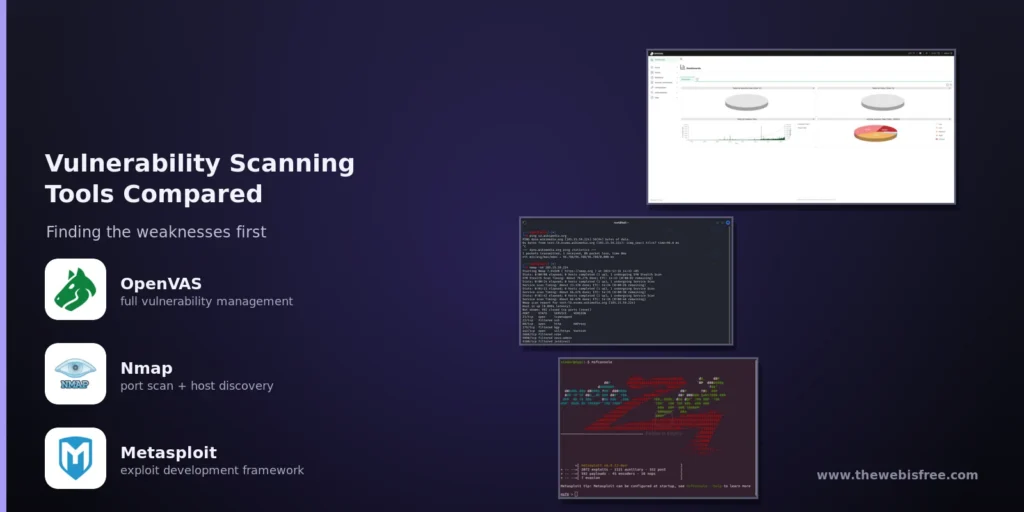
If you want to find the weaknesses in a network before someone else does, three open source tools come up again and again: Nmap, OpenVAS and the Metasploit Framework. They are often mentioned in the same breath, but they do very different jobs. Knowing where each one fits saves you from the “one tool does everything” myth.
OpenVAS — Vulnerability Scanning and Management
OpenVAS is the scanning engine at the heart of Greenbone’s vulnerability management stack. It is not a lone script but part of the Greenbone Community Edition, which bundles the scanner, the vulnerability manager (gvmd), a database backend and the Greenbone Security Assistant web interface.
OpenVAS works from a feed of Vulnerability Tests. Each test knows how to detect a specific flaw, from a missing patch to a misconfiguration. You point it at a set of hosts, schedule a scan, and it produces a prioritised report with severity scores, remediation advice and references.
Licence: the scanner is GPL-2.0 and the manager is AGPL-3.0 — free to self-host and modify. Commercial support and enterprise feeds are available separately.
Nmap — Network Mapping and Discovery
Nmap (Network Mapper), started by Gordon Lyon in 1997, is the workhorse of network reconnaissance. It answers a seemingly simple question very thoroughly: what is on this network, and what is it running?
Nmap discovers live hosts, scans TCP and UDP ports, fingerprints the operating system and detects service versions. Its Nmap Scripting Engine extends it with hundreds of scripts for banner grabbing, checking for default credentials and probing for known vulnerable services.
Nmap is deliberately lightweight and scriptable. Run it from a terminal in seconds, or drive it from other tools through its XML output.
Licence: released under the Nmap Public Source License (NPSL), a GPLv2-derived copyleft licence.
Metasploit Framework — Exploitation and Post-Exploitation
The Metasploit Framework, maintained by Rapid7, takes the next step: once a weakness is found, Metasploit provides the modules to exploit it. It ships thousands of exploit modules, payloads, encoders and auxiliary scanners, all driven from the msfconsole command line or generated with msfvenom.
Its well-known Meterpreter payload gives you an in-memory session on a compromised host for post-exploitation — privilege escalation, pivoting, credential gathering and lateral movement. That is why Metasploit is the tool of choice for penetration testers and red teams, and why it should only ever be pointed at systems you own or have written authorisation to test.
Licence: the Metasploit Framework is released under a BSD-3-Clause licence (some bundled components carry their own open source terms). Rapid7 sells Metasploit Pro as a commercial product alongside the free framework.
Head-to-Head Comparison
Primary purpose
- OpenVAS: Vulnerability assessment and management — find, prioritise and track the flaws on your hosts.
- Nmap: Network discovery and mapping — find the hosts, ports, services and operating systems.
- Metasploit: Exploitation — turn a known weakness into a working session.
Defensive or offensive focus
- OpenVAS: Defensive. Built for continuous security management and reporting.
- Nmap: Neutral. Reads the network the way an attacker would, but stops at discovery.
- Metasploit: Offensive. Designed to breach and control systems.
How you use it
- OpenVAS: Web interface and scheduled scans; results land in a database and can be exported as reports.
- Nmap: Command line, instantly; results as plain text or XML.
- Metasploit: Interactive
msfconsole, plusmsfvenom; scriptable through resource files and its RPC API.
Skill required
- OpenVAS: Moderate — the web UI hides most complexity, but interpreting results well takes experience.
- Nmap: Low at first, deeper once you start writing your own scripts.
- Metasploit: Higher — though the framework is well documented and guides you through each step.
Licensing and cost
- OpenVAS: GPL-2.0 scanner / AGPL-3.0 manager. Free; enterprise feeds and support are paid.
- Nmap: NPSL (GPLv2-derived). Free.
- Metasploit Framework: BSD-3-Clause. Free; Metasploit Pro is commercial.
Do they work together?
Yes — and this is the usual workflow. Use Nmap to map the network, feed its output into OpenVAS to assess the hosts you found, then use Metasploit to verify which of the reported flaws are actually exploitable. Discovery, assessment and exploitation are three stages of the same job.
Which One Should You Pick?
Choose Nmap if you need to know what is on your network right now. It is the fastest way to inventory hosts and services, and the natural first step of any assessment.
Choose OpenVAS if your job is ongoing vulnerability management — scanning a fleet of hosts on a schedule, tracking remediation over time and producing reports for other people.
Choose Metasploit if you are doing authorised penetration testing and need to prove exploitability, not just flag potential issues.
The Bottom Line
These three tools are not competitors — they are stages of one workflow. Nmap maps the terrain, OpenVAS tells you where the weaknesses are, and Metasploit shows whether those weaknesses can actually be exploited. Most security teams run all three, each where it fits best.
Both Nmap and OpenVAS are listed in our directory; the Metasploit Framework is not listed yet. Download them at nmap.org, greenbone.github.io and metasploit.com — free and open source.
Looking for more security tooling? Browse our Security & Privacy directory for more free software.